
The 2027 Exodus: Is The Economist revealing the conditions for Israel's flight into the wilderness?

The Enoch calendar, the coming distress of nations, the fall of Babylon, and the fulfillment of Revelation 12
On November 17, 2026, The Economist released its annual forecast, The World Ahead 2027. Its cover illustration presents a world descending into political upheaval, financial instability, warfare, technological control, environmental destruction, and mass displacement.
At the top of the illustration stand powerful political figures. Beneath them are governments, financial institutions, military weapons, artificial intelligence, pharmaceutical products, and disrupted energy infrastructure. At the bottom are people living among tents, carrying their belongings, and apparently struggling to survive.
Most people will look at this illustration and see a forecast of the problems facing the world in 2027.
I see another possibility.
For several years, I have been examining the prophecies concerning Israel's restoration, the second Exodus, and the woman fleeing into the wilderness in Revelation 12. My research has also involved the 364-day Enoch calendar and the possibility that 2027 represents a significant turning point in the prophetic timeline.
What caught my attention about The Economist's illustration was the relationship between its different symbols.
The image portrays the very conditions that scripture describes surrounding a period of judgment and deliverance: wars among nations, economic disruption, food insecurity, political instability, and people fleeing from places that have become dangerous.
And there is one detail that I consider especially important.
The homeless people and refugee tents at the bottom of the illustration may represent something far greater than an ordinary humanitarian crisis. They could reflect the circumstances surrounding Israel's flight into the wilderness.
What the world might identify as refugees could include Israelites leaving the nations during a period of judgment, exactly as the prophets describe.
I am examining this possibility because Revelation 12, Ezekiel 20, Isaiah 48, Jeremiah 51, and 2 Esdras 15–16 contain remarkable connections that deserve to be considered together.
1. The woman of Revelation 12 represents Israel
We must begin by identifying the woman.
Revelation 12:1 (KJV):
"And there appeared a great wonder in heaven; a woman clothed with the sun, and the moon under her feet, and upon her head a crown of twelve stars."
The symbolism immediately brings us back to Joseph's dream.
Genesis 37:9:
"And he dreamed yet another dream, and told it his brethren, and said, Behold, I have dreamed a dream more; and, behold, the sun and the moon and the eleven stars made obeisance to me."
Joseph's father understood the imagery as representing his family. The twelve stars of Revelation 12 correspond naturally with the twelve tribes of Israel.
Throughout scripture, Israel is also described as a woman, a wife, and a mother.
Isaiah 54:5:
"For thy Maker is thine husband; the LORD of hosts is his name; and thy Redeemer the Holy One of Israel; The God of the whole earth shall he be called."
Within this understanding, the woman of Revelation 12 represents Israel, and the male child is associated with Yahusha, who came through Israel.
This establishes the foundation for the wilderness prophecy.
Revelation 12:6:
"And the woman fled into the wilderness, where she hath a place prepared of God, that they should feed her there a thousand two hundred and threescore days."
Notice what the scripture says.
The woman flees.
She enters the wilderness.
Yahuah has prepared a place for her.
She is nourished there for 1,260 days.
These details describe a particular period of protection. The language also recalls the original Exodus, when Israel departed Egypt and depended upon Yahuah for survival in the wilderness.
2. Ezekiel 20 describes a second Exodus into the wilderness
Ezekiel 20:34–36:
"And I will bring you out from the people, and will gather you out of the countries wherein ye are scattered, with a mighty hand, and with a stretched out arm, and with fury poured out.
And I will bring you into the wilderness of the people, and there will I plead with you face to face.
Like as I pleaded with your fathers in the wilderness of the land of Egypt, so will I plead with you, saith the Lord GOD."
Consider what Yahuah is saying.
He will gather Israel out of the countries where the people have been scattered. He will bring them into the wilderness. He will deal with them there, just as He dealt with their fathers after the first Exodus.
The comparison with Egypt is explicit.
The passage also says that this gathering takes place with fury being poured out.
That detail matters because the gathering is associated with a period of judgment.
Revelation 12 describes the woman entering the wilderness for protection. Ezekiel 20 describes Israel being gathered from the nations into the wilderness during a period of divine fury.
I believe these passages may describe connected aspects of the same future deliverance.
Ezekiel 20:37–38 also tells us that Israel will pass under the rod of the covenant and that the rebels will be separated from the people.
The wilderness therefore serves two purposes.
It is a place of protection, and it is a place where Yahuah prepares and purifies His people.
That brings us directly to the refugee imagery on The Economist's cover.
3. The refugee tents: Could the world witness Israel's Exodus without recognizing it?
Look carefully at the bottom of the illustration.
We see people in temporary shelters, tents, and desolate surroundings. Some appear to have little more than the belongings they can carry.
Above them are symbols of warfare, economic disruption, political authority, artificial intelligence, and environmental destruction.
The arrangement suggests that ordinary people are bearing the consequences of events occurring throughout the world.
But suppose the prophetic Exodus occurs during a period of international crisis.
How would the world describe large numbers of people leaving their homes and countries?
They would probably be called migrants, displaced persons, or refugees.
News organizations would discuss a humanitarian emergency. Governments would focus on borders, immigration, transportation, housing, and security.
Yet scripture provides another perspective on people fleeing during judgment.
Jeremiah 51:6:
"Flee out of the midst of Babylon, and deliver every man his soul: be not cut off in her iniquity; for this is the time of the LORD'S vengeance; he will render unto her a recompence."
Jeremiah 51:45:
"My people, go ye out of the midst of her, and deliver ye every man his soul from the fierce anger of the LORD."
These are commands to leave a place facing judgment.
Notice the urgency.
Yahuah tells His people to flee and preserve their lives.
Jeremiah 51:50:
"Ye that have escaped the sword, go away, stand not still: remember the LORD afar off, and let Jerusalem come into your mind."
Those escaping the sword are instructed to keep moving.
Now compare that with Isaiah 48:20:
"Go ye forth of Babylon, flee ye from the Chaldeans, with a voice of singing declare ye, tell this, utter it even to the end of the earth; say ye, The LORD hath redeemed his servant Jacob."
The command to leave Babylon is connected directly to Jacob's redemption.
Then comes verse 21:
"And they thirsted not when he led them through the deserts: he caused the waters to flow out of the rock for them: he clave the rock also, and the waters gushed out."
Here we have the command to leave Babylon followed by the imagery of wilderness provision.
That connection is extraordinary.
Israel leaves captivity. Israel enters the wilderness. Yahuah provides what the people need to survive.
This is precisely the pattern found in Revelation 12.
And consider Isaiah 26:20–21:
"Come, my people, enter thou into thy chambers, and shut thy doors about thee: hide thyself as it were for a little moment, until the indignation be overpast.
For, behold, the LORD cometh out of his place to punish the inhabitants of the earth for their iniquity: the earth also shall disclose her blood, and shall no more cover her slain."
The principle is consistent: Yahuah provides refuge for His people during judgment.
I believe this gives us a different way to understand the homeless and refugee imagery.
What appears to the nations as displacement could, for some of Israel's remnant, be the beginning of deliverance.
The illustration itself does not identify the refugees as Israelites. That identification belongs to the prophetic interpretation I am examining. Nevertheless, the visual relationship between global crisis and people living in temporary shelters is remarkably relevant to the Exodus model.
4. The command to flee Babylon comes before the destruction is complete
Another important passage is Revelation 18:4.
"And I heard another voice from heaven, saying, Come out of her, my people, that ye be not partakers of her sins, and that ye receive not of her plagues."
Notice the timing.
The people are commanded to come out so that they will avoid participating in Babylon's sins and receiving her plagues.
This means the call to depart is connected with the approaching judgment.
Jeremiah 50:8 gives a similar instruction:
"Remove out of the midst of Babylon, and go forth out of the land of the Chaldeans, and be as the he goats before the flocks."
Within my model, Babylon represents the system of captivity and oppression from which Israel must ultimately be delivered.
The original historical context of these passages concerns ancient Babylon. Revelation also uses Babylon symbolically to describe a powerful system facing divine judgment.
The prophetic question is whether the final call to come out includes a physical gathering of the remnant during the period described in Revelation 12.
If so, the order of events becomes important.
The people receive the warning.
The nations enter a period of distress.
The remnant departs.
Judgment continues upon the system they have left.
This would explain why Revelation 12 describes the woman being protected in the wilderness while the dragon continues his warfare.
5. The Economist forecasts the conditions of international distress
The Economist's The World Ahead 2027 identifies several developments that could intensify instability.
Its projections include the consequences of the Iran war, concerns about China's military readiness regarding Taiwan, pressure on government bond markets, financial risks associated with artificial intelligence, extreme heat, food insecurity, and political uncertainty.
These subjects are especially relevant when compared with 2 Esdras 15–16.
Second Esdras 15:14–16:
"Woe to the world and them that dwell therein!
For the sword and their destruction draweth nigh, and one people shall stand up and fight against another, and swords in their hands.
For there shall be sedition among men, and invading one another; they shall not regard their kings nor princes, and the course of their actions shall stand in their power."
The prophecy describes warfare and social disorder affecting the nations.
Second Esdras 15:18–19:
"For because of their pride the cities shall be troubled, the houses shall be destroyed, and men shall be afraid.
A man shall have no pity upon his neighbour, but shall destroy their houses with the sword, and spoil their goods, because of the lack of bread, and for great tribulation."
The reference to the lack of bread is particularly important.
Warfare can disrupt agriculture, fertilizer production, transportation, and international trade.
The Economist's forecast identifies food insecurity as a potential consequence of the conflicts and environmental conditions affecting the world.
Second Esdras describes a world in which warfare, scarcity, and civil disorder occur together.
If those conditions intensify in 2027, they would resemble the circumstances described in these prophetic warnings.
The point is that the prophecies concern events taking place among real nations and populations.
A renewed Exodus would occur within that historical setting.
6. The falling financial markets: Could Babylon's economic system be shaken?
The Economist's illustration contains a sharply declining financial chart, stacks of money, and major institutional buildings.
These symbols correspond with its concerns about government debt, bond markets, and the financing of artificial intelligence.
The imagery also invites comparison with Revelation 18.
Revelation 18:11:
"And the merchants of the earth shall weep and mourn over her; for no man buyeth their merchandise any more."
Revelation 18:17:
"For in one hour so great riches is come to nought. And every shipmaster, and all the company in ships, and sailors, and as many as trade by sea, stood afar off."
The chapter describes a catastrophic commercial collapse.
Merchants mourn. Maritime trade is affected. Great wealth disappears.
The Economist's illustration contains a cargo ship, chains, industrial structures, financial symbols, and military conflict.
Those images resemble several economic elements found in Revelation 18.
Within my model, a major financial disruption could become part of the judgment that precedes or accompanies Israel's departure.
The first Exodus also provides an instructive pattern.
Pharaoh increased Israel's burdens before the people were delivered.
Exodus 5:7:
"Ye shall no more give the people straw to make brick, as heretofore: let them go and gather straw for themselves."
The oppression intensified before deliverance.
A future economic crisis might similarly increase hardship before the remnant's gathering.
The Economist forecasts financial risks. Revelation 18 describes a particular judgment upon Babylon. Their relationship is worth examining as events unfold, especially if financial instability becomes connected with widespread displacement.
7. Artificial intelligence and the coming struggle over economic participation
At the center of The Economist's illustration is a large artificial intelligence brain.
Surrounding it are microchips, robotics, pharmaceuticals, financial institutions, and communications infrastructure.
This placement suggests that AI is becoming central to modern civilization.
Revelation 13:16–17 describes a system in which economic participation is restricted:
"And he causeth all, both small and great, rich and poor, free and bond, to receive a mark in their right hand, or in their foreheads:
And that no man might buy or sell, save he that had the mark, or the name of the beast, or the number of his name."
The passage describes authority over buying and selling.
Modern digital systems increasingly connect identity verification, financial transactions, communications, and automated decision-making.
Artificial intelligence may strengthen the ability of institutions to administer such systems.
I have considered whether digital identification and centralized financial infrastructure could eventually become components of the economic control described in Revelation 13.
The chronological relationship is especially interesting.
Revelation 12 describes the woman's flight into the wilderness. Revelation 13 then describes the beast's authority and economic restrictions.
The chapters contain overlapping prophetic perspectives, but one possible interpretation is that the woman escapes before the complete implementation of the system described in Revelation 13.
If so, the Exodus could begin while the surrounding world is moving toward greater economic and technological control.
That possibility fits the proposed 2027 timeline.
8. China, Taiwan, the Middle East, and the widening of international conflict
The Chinese dragon, Chinese flag, missiles, satellites, aircraft, and military vehicles dominate several sections of the illustration.
The Economist identifies 2027 as an important year concerning China's military preparations for a possible Taiwan operation.
The distinction between military readiness and an actual decision to invade is important.
Nevertheless, the strategic implications are substantial.
A confrontation involving Taiwan could disrupt semiconductor manufacturing, international shipping, and global financial markets.
The Middle Eastern imagery also reflects the consequences of the Iran war, including energy insecurity and pressure on food supplies.
The broken pipeline and chained cargo vessel reinforce the relationship between warfare and economic disruption.
Second Esdras 15 describes nations rising against one another.
The Economist's forecasts identify several regions in which military and economic pressures may intensify.
The connection to the Exodus model is that widespread conflict could create the circumstances in which populations are displaced and existing systems become increasingly unstable.
Revelation 12:12 warns:
"Woe to the inhabiters of the earth and of the sea! for the devil is come down unto you, having great wrath, because he knoweth that he hath but a short time."
The warning concerns the inhabitants of the earth and sea.
The prophecy then describes the dragon persecuting the woman.
Within my model, worldwide distress and the persecution of Israel are connected developments, with the woman's flight following the threat directed against her.
9. The burning forests and extreme weather: Another source of displacement
The Economist's illustration contains burning forests, a thermometer, damaged landscapes, and people living in temporary shelters.
Its 2027 forecast includes the possibility of extreme heat, drought, wildfires, and food insecurity.
These conditions can force people from their homes and disrupt the production and distribution of essential goods.
Second Esdras 16 contains warnings concerning famine, destruction, and widespread calamity.
Second Esdras 16:18–19:
"The beginning of sorrows and great mournings; the beginning of famine and great death; the beginning of wars, and the powers shall stand in fear; the beginning of evils! what shall I do when these evils shall come?
Behold, famine and plague, tribulation and anguish, are sent as scourges for amendment."
The passage describes multiple calamities occurring within the same period.
The relationship to The Economist's illustration is the convergence of different forms of distress.
War affects energy and food supplies. Economic instability increases hardship. Environmental disasters destroy homes and infrastructure.
Together, these developments can produce displacement on a large scale.
That brings us back to the refugee tents.
If the prophetic gathering occurs during such conditions, the remnant's movement might take place alongside wider humanitarian migrations.
The world could witness a refugee crisis without understanding the prophetic interpretation that some participants place upon their departure.
10. The Enoch calendar and the proposed 2027 beginning
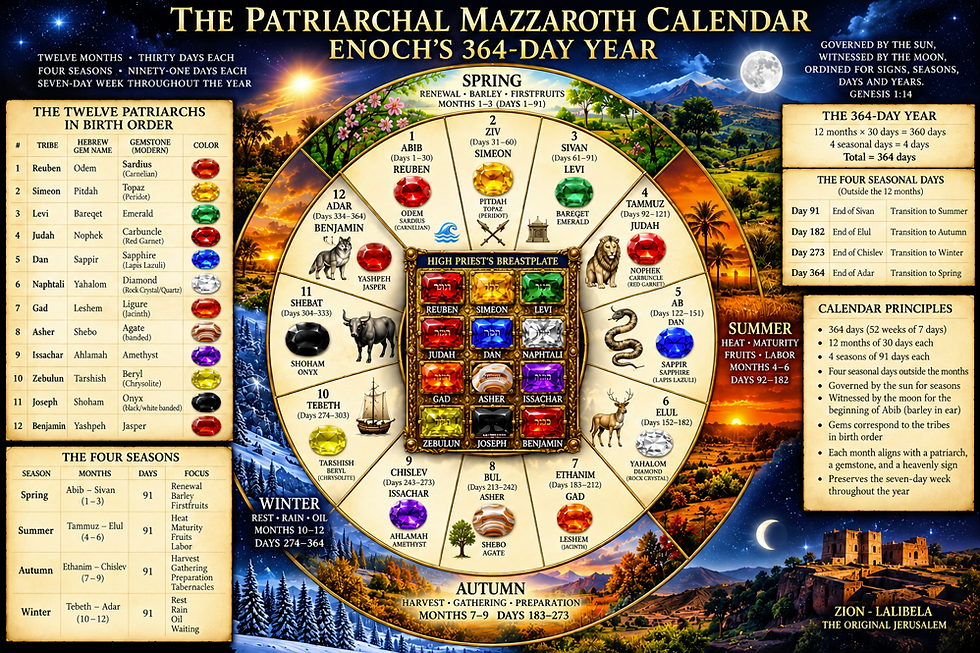
My calendar research uses the 364-day Enoch calendar, arranged into four quarters of 91 days.
The months follow a repeating pattern of 30, 30, and 31 days.
The year begins on a Wednesday, with an intercalary week inserted when necessary to preserve seasonal alignment.
Under the rule I have been examining, Abib 1 falls on the first Wednesday following the March equinox at the proposed Ethiopian calendar location.
For 2027, this produces March 24.
My model also identifies the period from Abib 2019 to Abib 2027 as eight completed years.
The September 23, 2017 astronomical configuration serves as an earlier proposed marker associated with the heavenly sign of Revelation 12:1.
The proposed sequence is therefore:
September 2017: The heavenly sign and the beginning of an awakening.
Abib 2019: The beginning of the eight-year period.
November 2026: The Economist publishes its forecast of international instability for 2027.
Abib 1, March 24, 2027: A possible beginning of the wilderness period.
September 2030: The possible completion of 1,260 elapsed days.
Revelation 12:6 gives the period as 1,260 days.
Revelation 12:14 describes the same protection using the expression "a time, and times, and half a time."
If the 1,260 days begin on March 24, 2027, they conclude on September 4, 2030, using elapsed-day counting.
This calculation is straightforward under the proposed calendar.
The scriptural identification of March 24 as the appointed beginning remains the part of the model that must be established through the actual sequence of events.
11. The wilderness may begin before the world's greatest turmoil
One aspect of Revelation 12 deserves special attention.
The woman receives protection, but the dragon continues his opposition.
Revelation 12:17:
"And the dragon was wroth with the woman, and went to make war with the remnant of her seed, which keep the commandments of God, and have the testimony of Jesus Christ."
In this study, that remnant is understood as those keeping Yahuah's commandments and holding the testimony of Yahusha.
The passage suggests that the dragon's warfare continues after the woman receives protection.
This has important chronological implications.
The Exodus would not necessarily require every judgment to have already occurred.
The woman could enter the wilderness while warfare, economic collapse, political instability, and persecution continue elsewhere.
That possibility is especially relevant to the proposed 2027 beginning.
If the wilderness period extends into 2030, the surrounding nations could experience further upheaval during those 1,260 days.
The Exodus would then represent the beginning of a protected period for the woman, rather than the conclusion of the world's distress.
12. Isaiah 60: Darkness upon the nations, restoration for Israel
Isaiah 60:1–4:
"Arise, shine; for thy light is come, and the glory of the LORD is risen upon thee.
For, behold, the darkness shall cover the earth, and gross darkness the people: but the LORD shall arise upon thee, and his glory shall be seen upon thee.
And the Gentiles shall come to thy light, and kings to the brightness of thy rising.
Lift up thine eyes round about, and see: all they gather themselves together, they come to thee: thy sons shall come from far, and thy daughters shall be nursed at thy side."
The passage places Israel's restoration against a background of darkness upon the earth.
The nations experience darkness while Yahuah's glory rises upon Zion.
The scattered sons and daughters are gathered.
Within my model, this restoration follows the period of deliverance and purification.
The Economist's illustration depicts international darkness in political, economic, and humanitarian terms.
Isaiah 60 describes the restoration that Yahuah promises His people.
The prophetic interpretation is that the international crisis may provide the setting in which Israel's deliverance becomes visible.
13. Jeremiah 30: Jacob's trouble and the promise of deliverance
Jeremiah 30:7:
"Alas! for that day is great, so that none is like it: it is even the time of Jacob's trouble; but he shall be saved out of it."
The passage contains both distress and deliverance.
Jacob experiences trouble, but Yahuah promises salvation.
Jeremiah 30:10:
"Therefore fear thou not, O my servant Jacob, saith the LORD; neither be dismayed, O Israel: for, lo, I will save thee from afar, and thy seed from the land of their captivity; and Jacob shall return, and shall be in rest, and be quiet, and none shall make him afraid."
This is central to the Exodus model.
Israel is saved from afar and from the land of captivity.
The people eventually return and dwell in peace.
When compared with Ezekiel 20 and Revelation 12, Jeremiah 30 contributes another important element: the period of trouble is connected to the promise of deliverance.
The Economist's forecast raises the possibility of growing international distress in 2027.
The prophetic model asks whether that distress could coincide with the beginning of Jacob's deliverance.
14. The refugee imagery may be the most important part of the illustration
I want to return to the image itself.
At the top are powerful political figures.
Below them are governments, money, military forces, and advanced technologies.
The middle contains symbols of artificial intelligence, medicine, transportation, and institutional authority.
The lower portions contain warfare, destruction, damaged landscapes, and disrupted trade.
Finally, at the bottom, we find displaced people and tents.
The illustration presents the consequences of international turmoil through the experience of ordinary people.
For those examining the second Exodus, this is an important visual parallel.
Jeremiah commands Yahuah's people to flee Babylon.
Isaiah connects leaving Babylon with Jacob's redemption and wilderness provision.
Ezekiel describes Israel being gathered from the nations into the wilderness.
Revelation 12 describes the woman fleeing into a prepared place and being nourished for 1,260 days.
These passages establish a repeated relationship between departure, wilderness, protection, and restoration.
The refugee imagery gives that relationship a modern visual form.
The possibility I am examining is that a movement described by the world as homelessness, migration, or displacement could overlap with the gathering of Israel into the wilderness.
This interpretation concerns the potential fulfillment of the prophetic passages.
15. What would establish the prophetic sequence?
The proposed model brings together several developments.
First, the world enters a period of intensifying international distress, resembling the warfare, scarcity, and disorder described in 2 Esdras 15–16.
Second, the economic and political systems associated with Babylon experience increasing instability.
Third, the remnant identified with Israel faces a recognizable threat or persecution corresponding to Revelation 12:13.
Fourth, Yahuah gathers His people from the nations, as described in Ezekiel 20.
Fifth, the woman enters the wilderness and receives nourishment for 1,260 days.
Finally, the period of wilderness preparation leads toward the restoration promised in the prophets.
The Economist's forecasts concern several developments associated with the first two stages.
The refugee imagery provides a visual parallel to the fourth and fifth.
The critical prophetic development would be the identifiable gathering and protection of the woman.
This is why the events of 2027 deserve attention within the proposed calendar model.
The forecast does not determine the fulfillment of prophecy. The events themselves must establish whether the proposed connections are correct.
Conclusion: Could 2027 mark the beginning of Israel's wilderness experience?
The Economist's The World Ahead 2027 portrays a world facing international conflict, financial instability, technological transformation, food insecurity, environmental destruction, and mass displacement. These developments resemble several conditions described in 2 Esdras 15–16, Jeremiah 30, and the judgments associated with Babylon.
The refugee tents and homeless populations are especially significant to my interpretation. Scripture repeatedly commands Yahuah's people to flee places facing judgment. Isaiah connects the departure from Babylon with Jacob's redemption and wilderness provision.
Ezekiel describes a gathering from the nations into the wilderness. Revelation 12 describes the woman fleeing into a prepared place, where she is nourished for 1,260 days.
My Enoch-calendar model identifies Abib 2027, beginning March 24, as a possible starting point for that wilderness period. If the 1,260 days began then, the period would extend into September 2030.
The convergence of these dates, prophetic passages, and geopolitical forecasts creates a specific hypothesis that can be examined against unfolding events.
I believe the refugee imagery is particularly important because the second Exodus would involve people physically departing the nations. Such a movement might appear to the world as displacement during a period of international crisis, while those interpreting it prophetically would recognize the possibility of Israel's gathering.
The central question is whether 2027 will bring the particular persecution, departure, and divine protection described in Revelation 12.
What the nations might call a refugee crisis could, within this prophetic model, include the beginning of Israel's second Exodus. And what appears to the world as homelessness could represent the opening stage of a journey toward restoration.
The scriptures establish the promised gathering. The Enoch calendar supplies a proposed timeframe. The Economist's forecast identifies circumstances that could accompany it.
The events of 2027 will provide the test of whether these elements truly converge.
Research note: This article presents a proposed prophetic interpretation. The Economist's geopolitical forecasts, the calendar calculations, and the identification of future events with biblical prophecy are distinct elements of the analysis. Historical passages concerning Babylon are applied typologically to the proposed future Exodus.
Reference: The Economist Group, “The Economist launches The World Ahead 2027,” November 17, 2026.
Enoch Model: https://www.teotwministries.com/post/a-speculative-model-are-we-approaching-the-second-exodus



Comments