
The Hidden Order of the Twelve Stones: What Ancient Records Reveal

The twelve stones of Israel: What the Septuagint and Josephus reveal
The high priest’s breastplate, the birth order of the patriarchs, and the testimony of ancient sources
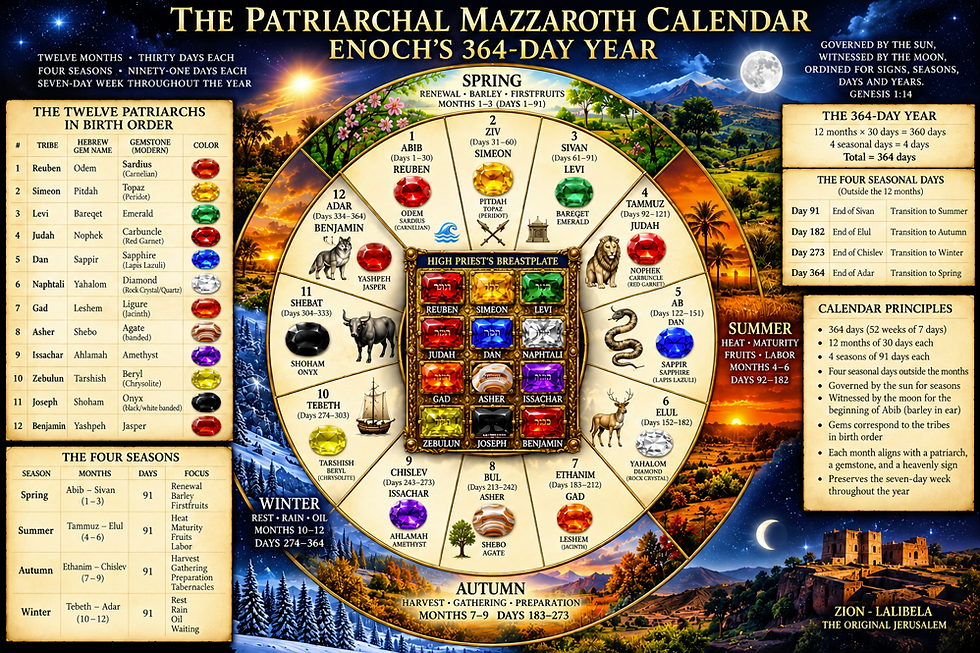
Illustrated Patriarchal Mazzaroth calendar. Decorative reconstruction; individual labels should be checked against the primary texts.
The twelve stones were a memorial of the twelve sons of Israel
When Yahuah commanded Moses to prepare Aaron’s garments, twelve precious stones were to be mounted upon the breastplate of judgment. Each stone bore a name representing one of the twelve tribes of Israel. The stones served as a memorial of the covenant people before Yahuah, carried over the high priest’s heart in the sanctuary.
Which stone belonged to which patriarch? The answer requires the Hebrew Scriptures, the Greek Septuagint, the first-century historian Flavius Josephus, and the birth sequence in Genesis. Scripture establishes twelve stones and twelve names; Josephus expressly says the breastplate names followed birth order. The Septuagint provides an ancient Greek sequence of gemstone names, although Josephus differs at several positions.
1. Yahuah commanded twelve stones for the twelve tribes
Exodus 28:15 (KJV): And thou shalt make the breastplate of judgment with cunning work; after the work of the ephod thou shalt make it; of gold, of blue, and of purple, and of scarlet, and of fine twined linen, shalt thou make it.
Exodus 28:17–20 (KJV): And thou shalt set in it settings of stones, even four rows of stones: the first row shall be a sardius, a topaz, and a carbuncle: this shall be the first row. And the second row shall be an emerald, a sapphire, and a diamond. And the third row a ligure, an agate, and an amethyst. And the fourth row a beryl, and an onyx, and a jasper: they shall be set in gold in their inclosings.
Exodus 28:21 (KJV): And the stones shall be with the names of the children of Israel, twelve, according to their names, like the engravings of a signet; every one with his name shall they be according to the twelve tribes.
Exodus 28:29 (KJV, divine name adapted): And Aaron shall bear the names of the children of Israel in the breastplate of judgment upon his heart, when he goeth in unto the holy place, for a memorial before Yahuah continually.
The arrangement was four rows of three stones. Every stone bore a tribal name, representing the nation collectively and its tribes individually.
2. The birth order of Jacob’s twelve sons
Genesis 29:32–35; 30:1–24; and 35:16–18 provide the chronological birth sequence. It differs from later camp arrangements and from groupings by mother.
Birth order | Patriarch | Mother |
1 | Reuben | Leah |
2 | Simeon | Leah |
3 | Levi | Leah |
4 | Judah | Leah |
5 | Dan | Bilhah |
6 | Naphtali | Bilhah |
7 | Gad | Zilpah |
8 | Asher | Zilpah |
9 | Issachar | Leah |
10 | Zebulun | Leah |
11 | Joseph | Rachel |
12 | Benjamin | Rachel |
Under a chronological assignment, Judah is fourth, Dan fifth, Naphtali sixth, and Issachar ninth.
3. Josephus explicitly confirms the birth-order principle
In Antiquities of the Jews, Book 3, chapter 7, section 5, Josephus describes the twelve breastplate stones and states that each was honored with a name in the order of the sons’ births. This is the clearest ancient explicit support for applying birth order to the breastplate.
Exodus 28:10 (KJV): Six of their names on one stone, and the other six names of the rest on the other stone, according to their birth.
Exodus 28:10 expressly concerns the two shoulder stones. Exodus 28:21 requires names on the breastplate but does not expressly specify which name goes on which gemstone. Josephus extends the birth-order principle to the breastplate itself. Other Israelite traditions preserve different assignments, so the historical distinction matters.
4. The Septuagint preserves a different gemstone sequence
The ancient Greek translation of Exodus 28:17–20 lists the following stones in four rows:
Row | First stone | Second stone | Third stone |
1 | Sardius | Topaz | Emerald |
2 | Carbuncle | Sapphire | Jasper |
3 | Ligure | Agate | Amethyst |
4 | Chrysolite | Beryl | Onyx |
In this Greek order, carbuncle is fourth, corresponding to Judah if birth order determines the name assignment. Emerald is third, corresponding to Levi. This combination of the Septuagint stone sequence and Josephus’s birth-order statement is the basis of the reconstruction.
5. The twelve stones and their tribal associations
Patriarch | Hebrew name | Septuagint stone | Representative color |
Reuben | Odem | Sardius | Red |
Simeon | Pitdah | Topaz | Golden yellow |
Levi | Bareqet | Emerald | Green |
Judah | Nophek | Carbuncle | Deep red |
Dan | Sappir | Sapphire | Deep blue |
Naphtali | Yahalom | Jasper | Variable |
Gad | Leshem | Ligure | Amber-orange (tentative) |
Asher | Shebo | Agate | Banded, multicolored |
Issachar | Ahlamah | Amethyst | Purple |
Zebulun | Tarshish | Chrysolite | Yellow-green |
Joseph | Shoham | Beryl | Green-blue, variable |
Benjamin | Yashpeh | Onyx | Dark or banded |
The colors are representative illustrations, not an ancient specification of exact shades. Jasper, agate, beryl, and onyx vary widely. Ancient mineral names do not always map onto modern mineral classifications; Greek sappheiros may refer to lapis lazuli rather than modern sapphire.

Illustrative color guide to the Septuagint birth-order reconstruction, including Judah’s red carbuncle.
6. Josephus’s gemstone list differs from the Septuagint
Josephus gives this sequence in Antiquities, Book 3, chapter 7, section 5:
Row | First stone | Second stone | Third stone | ||
1 | Sardonyx | Topaz | Emerald | ||
2 | Carbuncle | Jasper | Sapphire | ||
3 | Ligure | Amethyst | Agate | ||
4 | Chrysolite | Onyx | Beryl | ||
Patriarch | Septuagint | Josephus, Antiquities | |||
Reuben | Sardius | Sardonyx | |||
Simeon | Topaz | Topaz | |||
Levi | Emerald | Emerald | |||
Judah | Carbuncle | Carbuncle | |||
Dan | Sapphire | Jasper | |||
Naphtali | Jasper | Sapphire | |||
Gad | Ligure | Ligure | |||
Asher | Agate | Amethyst | |||
Issachar | Amethyst | Agate | |||
Zebulun | Chrysolite | Chrysolite | |||
Joseph | Beryl | Onyx | |||
Benjamin | Onyx | Beryl | |||
Both lists place emerald third and carbuncle fourth. They differ in other positions, including Dan and Naphtali, Asher and Issachar, and Joseph and Benjamin. Josephus also differs in some details between Jewish War and Antiquities. The evidence should therefore be presented as an ancient interpretation rather than an uncontested assignment of all twelve stones.
7. Why Judah’s gemstone is the carbuncle
Three elements converge: Judah is the fourth son in Genesis 29:35; Exodus 28 establishes twelve stones engraved with the tribes’ names; and Josephus states that the names followed the birth order. The fourth stone is carbuncle in both the Septuagint and Josephus’s Antiquities.
The Hebrew fourth stone is Nophek (נֹפֶךְ), rendered anthrax (ἄνθραξ) in the Greek tradition, a word associated with a glowing coal or brilliant red gem. A deep-red carbuncle is a traditional and fitting illustration, although the exact ancient mineral remains debated.
Genesis 49:9 (KJV): Judah is a lion’s whelp: from the prey, my son, thou art gone up: he stooped down, he couched as a lion, and as an old lion; who shall rouse him up?
Genesis 49:10 (KJV): The sceptre shall not depart from Judah, nor a lawgiver from between his feet, until Shiloh come; and unto him shall the gathering of the people be.
Genesis supplies the lion and royal imagery; the red carbuncle association arises from the breastplate reconstruction. These are related but distinct lines of interpretation.
8. The stones, the twelve months, and the Mazzaroth
Josephus, Antiquities Book 3, chapter 7, section 7, connects the twelve stones with the twelve months or heavenly signs, and discusses the shoulder stones in relation to the sun and moon. This offers ancient testimony for heavenly symbolism in the priestly garments.
Genesis 1:14 (KJV, divine title adapted): And Elohim said, Let there be lights in the firmament of the heaven to divide the day from the night; and let them be for signs, and for seasons, and for days, and years.
Job 38:32 (KJV): Canst thou bring forth Mazzaroth in his season? or canst thou guide Arcturus with his sons?
Josephus does not supply a complete tribe-by-constellation calendar. Mapping Reuben to Abib and each following son to a successive month is a further reconstruction, not a direct quotation from Josephus.

Decorative Mazzaroth illustration. Calendar labels and Gregorian alignments are provisional reconstructions, not statements from Josephus.
9. The breastplate and the New Jerusalem
Revelation 21:12 (KJV): And had a wall great and high, and had twelve gates, and at the gates twelve angels, and names written thereon, which are the names of the twelve tribes of the children of Israel:
Revelation 21:19–20 (KJV): And the foundations of the wall of the city were garnished with all manner of precious stones. The first foundation was jasper; the second, sapphire; the third, a chalcedony; the fourth, an emerald; The fifth, sardonyx; the sixth, sardius; the seventh, chrysolyte; the eighth, beryl; the ninth, a topaz; the tenth, a chrysoprasus; the eleventh, a jacinth; the twelfth, an amethyst.
Revelation also names the twelve apostles on the foundations (21:14). Its foundation-stone sequence differs from Exodus, so it is a related twelvefold symbolism rather than an identical breastplate listing.
10. What the historical evidence establishes
1. Exodus 28 and 39 establish twelve named precious stones on the breastplate.
2. Genesis establishes the chronological birth order of Jacob’s sons.
3. Exodus 28:10 explicitly specifies birth order for the shoulder stones.
4. Josephus expressly applies birth order to the breastplate names.
5. The Septuagint places emerald third and carbuncle fourth.
6. Josephus’s Antiquities likewise places emerald third and carbuncle fourth, supporting Levi–emerald and Judah–carbuncle under the birth-order interpretation.
7. Josephus relates the twelve stones to the twelve months or heavenly signs.
8. Other gemstone identities and tribe assignments remain disputed; exact historical colors are not uniformly recoverable.
The central conclusion is clear within this ancient reconstruction: Judah is fourth in birth order, and carbuncle is fourth in both the Septuagint and Josephus’s Antiquities. The breastplate symbolizes the covenant nation and provides a documented starting point for examining the patriarchs, the calendar, and the Mazzaroth.
Primary sources and further reading
· Septuagint, Exodus 28:15–21, Brenton translation: https://ebible.org/eng-Brenton/EXO28.htm
· Josephus, Antiquities of the Jews, Book 3, chapter 7: https://adfonteslibrary.org/work-st-josephus-antiquities-3
· Jewish Encyclopedia, Breastplate of the High Priest: https://www.jewishencyclopedia.com/articles/3668-breastplate-ofthe-high-priest
· Miller-Naudé and Naudé (2020), comparison of gemstone lists: https://hts.org.za/index.php/hts/article/view/6141/16346
· Josiah Derby, Rashi’s Conjectures: https://www.jewishbible.org/articles/rashis-conjectures/


Comments