
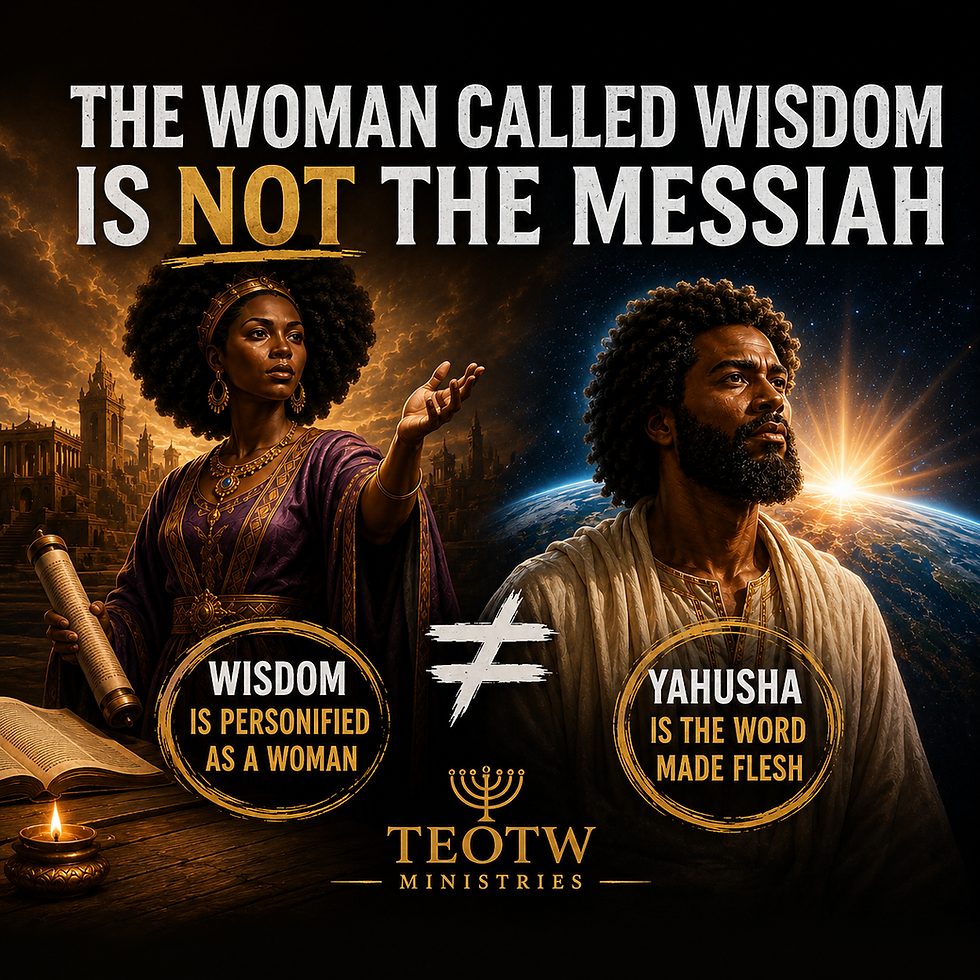
The Woman Called Wisdom Is Not the Messiah:Why Proverbs 8 Can’t Be Used to Claim Yahusha Was Created

One argument against Yahusha’s eternal deity starts with Proverbs 8:22. It usually works backward from the conclusion people want. Wisdom existed before creation. The New Testament calls Messiah the wisdom of God. Therefore the Wisdom speaking in Proverbs 8 must be Yahusha. Then they take Proverbs 8:22, translate or interpret it to mean Yah “created” Wisdom, and use that to say Yahusha Himself was created.
There’s a real problem with that line of reasoning.
Proverbs never identifies the speaker in chapter 8 as Yahusha. It identifies the speaker as Wisdom and deliberately pictures Wisdom as a woman.
The created-Messiah argument needs two things the text never actually gives us. First, it needs Wisdom to somehow become Yahusha. Second, it needs “possessed me” to become “created me.” Neither of those should just be handed over without real Scriptural support.
When Scripture talks directly about the Word who became flesh, the language is completely different. John tells us the Word already existed “in the beginning,” that the Word was God, that everything that was made was made through Him, and that this Word became flesh.
We ought to let the clear passages about Yahusha explain Yahusha, instead of turning a female poetic figure in Proverbs into the Messiah and then using that assumption to contradict what John says straight out.
Proverbs Tells Us Who Is Speaking
We don’t have to guess who is talking in Proverbs 8. The chapter introduces its own speaker:
“Doth not wisdom cry? and understanding put forth her voice?” Proverbs 8:1 KJV
A few verses later she identifies herself:
“I wisdom dwell with prudence, and find out knowledge of witty inventions.” Proverbs 8:12 KJV
The text says Wisdom. It does not say Messiah. It does not say the Son. It does not say the Word. It does not say Yahusha.
So before anyone can turn Proverbs 8 into a statement about Yahusha’s origin, they have the job of showing from Scripture that this Wisdom is actually Yahusha. Just asserting the connection doesn’t make it so.
Wisdom Is Deliberately Presented as a Woman
It gets even harder when you look at how Proverbs describes Wisdom.
Wisdom isn’t just an abstract idea that happens to speak once in chapter 8. Proverbs keeps personifying Wisdom as a woman.
Long before chapter 8 we already read:
“Wisdom crieth without; she uttereth her voice in the streets:” Proverbs 1:20 KJV
Proverbs 3 keeps it going:
“Happy is the man that findeth wisdom, and the man that getteth understanding.” Proverbs 3:13 KJV
Then:
“She is more precious than rubies: and all the things thou canst desire are not to be compared unto her.” Proverbs 3:15 KJV
And:
“Length of days is in her right hand; and in her left hand riches and honour.” Proverbs 3:16 KJV
This female picture runs all the way through the book.
Proverbs 9 gives the clearest example:
“Wisdom hath builded her house, she hath hewn out her seven pillars:” Proverbs 9:1 KJV
She prepares food:
“She hath killed her beasts; she hath mingled her wine; she hath also furnished her table.” Proverbs 9:2 KJV
She even has maidens she sends out:
“She hath sent forth her maidens: she crieth upon the highest places of the city,” Proverbs 9:3 KJV
Are we supposed to believe that Yahusha is literally a woman who built a house, slaughtered animals, mixed wine, set a table, and sent out her maidens? Of course not. We’re reading personification.
Proverbs takes the idea of Wisdom and gives her a voice, a body, a house, a table, hands, servants, and actions. The writer makes an abstract quality stand in front of the reader as a woman calling people to choose the path of wisdom.
Proverbs Does the Same Thing With Folly
The literary pattern gets even clearer because Proverbs doesn’t only personify Wisdom. It also personifies Folly as another woman.
Proverbs 9 says:
“A foolish woman is clamorous: she is simple, and knoweth nothing.” Proverbs 9:13 KJV "Folly is an unruly woman; she is simple and knows nothing." Proverbs 9:13 NIV
She also sits at her house:
“For she sitteth at the door of her house, on a seat in the high places of the city,” Proverbs 9:14 KJV
And she calls out to people:
“To call passengers who go right on their ways:” Proverbs 9:15 KJV
It’s an intentional contrast. Woman Wisdom calls people toward life. Woman Folly calls them toward destruction. The writer gives both ideas personalities so the choice feels real and vivid - two women, each calling from her house, inviting the simple to follow her.
Nobody needs to invent two literal heavenly women to understand the passage. So why should the literary personification suddenly vanish when someone gets to Proverbs 8:22? It shouldn’t.
“Christ the Wisdom of God” Does Not Turn Woman Wisdom Into Yahusha
The strongest connection people try to make between Proverbs 8 and Yahusha comes from Paul:
“But unto them which are called, both Jews and Greeks, Christ the power of God, and the wisdom of God.” 1 Corinthians 1:24 KJV
That tells us something deep about Messiah. But it does not say the female personification of Wisdom in Proverbs is literally Yahusha.
There’s a difference between saying “Yahusha is the wisdom of God” and saying “Every personification of wisdom in Scripture is Yahusha.” The first comes straight from Scripture. The second does not.
Think about how Yahusha describes Himself elsewhere. He says:
“I am the door: by me if any man enter in, he shall be saved...”John 10:9 KJV
And:
“I am the true vine, and my Father is the husbandman.”John 15:1 KJV
Yahusha is the door. Yahusha is the true vine. But we don’t go hunting through the Old Testament for every door and every vine and claim those objects must literally be Him. The metaphors tell us something about Him. The same principle applies when Paul calls Messiah “the wisdom of God.” Paul’s statement doesn’t give us permission to turn the female literary character of Proverbs into Yahusha.
Proverbs 8:22 Does Not Say “Yahuah Created Me”
There’s another big problem with using Proverbs 8:22 to prove a created Messiah.
Here’s what the KJV actually says:
“The LORD possessed me in the beginning of his way, before his works of old.” Proverbs 8:22 KJV
Notice what it does not say. It does not say “The LORD created me.”
The Hebrew verb translated “possessed” is qanah. It can carry meanings of possession or acquisition. Translators and scholars have debated how it should be rendered in this particular place.
That matters because someone can’t just change “Yahuah possessed me” into “Yahuah created me out of nothing” and then treat that interpretation as if the Hebrew text said it outright.
So the created-Messiah argument rests on two separate claims.
First: the woman called Wisdom in Proverbs 8 is actually Yahusha. Where does Proverbs say that? It doesn’t.
Second: “Yahuah possessed me” means “Yahuah created me from nonexistence.” That conclusion has to be demonstrated, not just inserted into the passage.
The argument ends up looking like this: Wisdom = Yahusha. Then “possessed” = "created from nothing". Therefore Yahusha was created.
But if the first two steps haven’t been established, the conclusion hasn’t been established either. You can’t stack one assumption on top of another and call the result Scripture.
The Same Chapter Says “From Everlasting”
There’s another statement that should make us slow down.
Right after Proverbs 8:22, Wisdom says:
“I was set up from everlasting, from the beginning, or ever the earth was.” Proverbs 8:23 KJV
You can’t responsibly isolate “possessed me,” interpret it as “created me,” apply it to Yahusha without first proving that identity, and then ignore the very next verse that describes Wisdom as being “from everlasting.” The surrounding passage has to guide how we read it.
If We Want to Know About Yahusha, Read the Passages That Actually Identify Him
This is where it gets simpler.
If the question is “Was Yahusha created?”, why start with a poetic passage about a woman named Wisdom whose connection to Yahusha has to be assumed first?
Scripture gives us passages that speak directly about the One who became flesh.
John begins:
“In the beginning was the Word, and the Word was with God, and the Word was God.”John 1:1 KJV
Notice the language. John does not say “In the beginning the Word was created. He says “In the beginning was the Word.” The Word is already there.
Then he makes it even stronger:
“All things were made by him; and without him was not any thing made that was made.”John 1:3 KJV
John sets up two categories: the Word, and the things that were made. Everything that belongs to the category of things that were made was made through the Word.
Then he tells us what happened to this Word:
“And the Word was made flesh, and dwelt among us...”John 1:14 KJV
Now we’re dealing with a passage whose identification doesn’t have to be invented. The Word became flesh. This is about Yahusha.
John 1:3 Creates a Real Problem for a Created Messiah
John 1:3 needs special attention:
“All things were made by him; and without him was not any thing made that was made.”
If Yahusha were Himself a created being, then He would belong to the category John calls “anything made that was made.” But John says that without the Word, nothing in that category was made.
A created-Messiah view has to explain how the Word could belong to the category of created things while at the same time being the One through whom the entire category of created things came into existence. John’s statement puts the Word on the side of the One through whom creation came, not among the things that were created. That’s direct testimony about the Word who became flesh.
Clear Identification Should Come Before Assumed Identification
This gives us a solid rule for studying Scripture. A passage that explicitly identifies Yahusha should carry more weight about His identity than a passage whose link to Him has to be assumed first.
John explicitly identifies the Word who became flesh. Proverbs explicitly identifies Wisdom. John calls the Word God. Proverbs portrays Wisdom as a woman. John says everything that was made was made through the Word. Proverbs uses poetic personification to show Wisdom and Folly as two competing women calling people toward different paths.
We shouldn’t take the poetic character from Proverbs, declare without clear Scriptural identification that she is Yahusha, reinterpret “possessed” as “created from nothing,” and then use those assumptions to overturn John’s direct testimony about the Word. That turns sound interpretation upside down.
Woman Wisdom Is Not Evidence of a Created Messiah
Proverbs 8 is a beautiful description of the importance, age, and place of divine Wisdom. But it does not identify Woman Wisdom as Yahusha. The text gives us no reason to turn her into the Messiah.
The surrounding chapters actually give strong reasons not to do that, because Proverbs repeatedly uses female personification as a literary device. Wisdom speaks. Wisdom walks. Wisdom has hands. Wisdom builds a house. Wisdom prepares a table. Wisdom has maidens. Folly is likewise shown as another woman who speaks and invites people into her house. That’s the literary world Proverbs creates.
Paul calling Yahusha “the wisdom of God” doesn’t change that woman into Messiah any more than Yahusha calling Himself the Door makes every biblical door into Messiah.
And even after someone assumes Wisdom is Yahusha, Proverbs 8:22 still doesn’t plainly say Wisdom was created. The KJV says Yahuah “possessed” Wisdom.
So Proverbs 8:22 simply can’t carry the weight people put on it when they use it to argue for a created Messiah. The argument requires us to assume the identity first and then assume the meaning of “possessed” second. Only after making both assumptions can someone reach the conclusion that Yahusha was created.
Scripture gives us a much clearer path:
“In the beginning was the Word, and the Word was with God, and the Word was God.” John 1:1 KJV
“All things were made by him; and without him was not any thing made that was made.” John 1:3 KJV
“And the Word was made flesh, and dwelt among us...” John 1:14 KJV
That’s where TEOTW Ministries stands.
Yahusha is Yahuah manifested in the flesh. He is not the created Woman Wisdom of Proverbs 8, because Scripture never identifies Woman Wisdom as Yahusha in the first place.
If someone wants to claim otherwise, the burden is straightforward: show from Scripture that the woman speaking as Wisdom in Proverbs 8 is Yahusha before using anything she says as evidence about the origin of Messiah.
Until that connection is established from Scripture, Proverbs 8:22 cannot be used to prove that Yahusha was created.


Comments