
Partners in Deception: How China and the West Are Engineering a New World Order

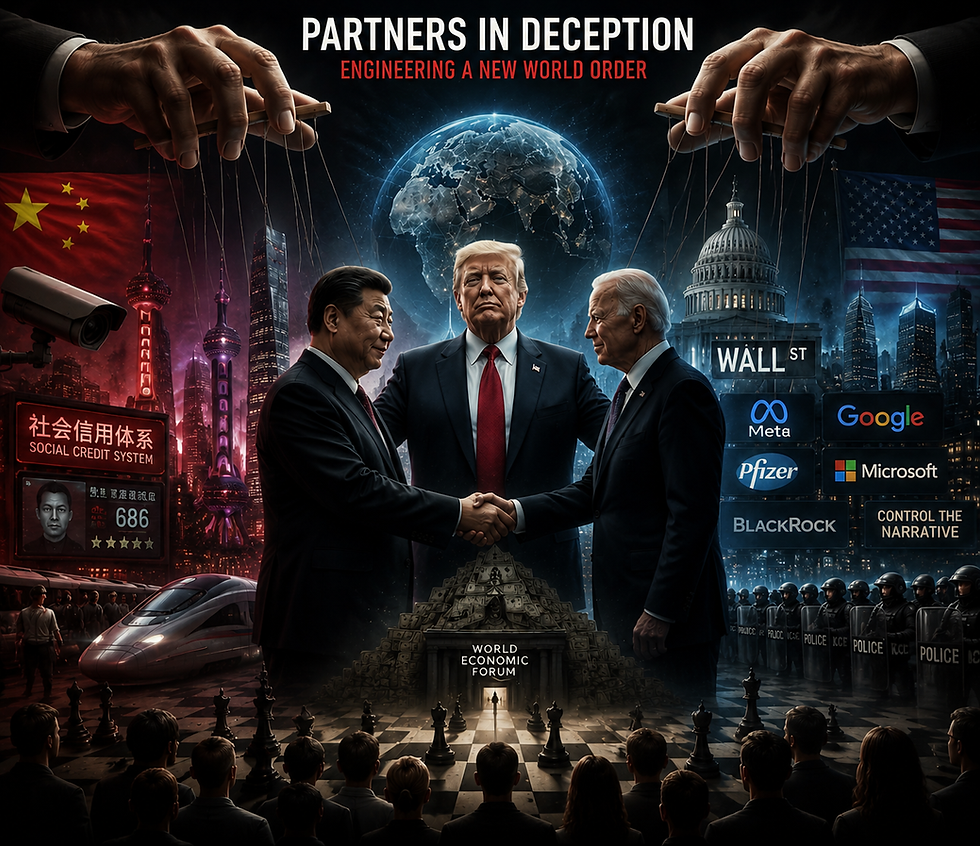
Something really strange has been happening in the world over the past forty years. If you step back and look at the big picture, the loud rivalry between the United States, the West, and China starts to feel like an elaborate stage play. The public arguments, the tariffs, the military tensions, the dramatic headlines about threats to our way of life, it all looks like a carefully scripted show with fake adversaries and orchestrated conflicts. In reality, when you study the clear patterns, China and the West are not true enemies at all. They are working together toward the same long-term goal: building a technocratic state where governments and powerful institutions use advanced technology to police, monitor, and control every aspect of citizens’ lives. This wasn’t by accident or simple coincidence. It was a long-term, carefully funded and coordinated plan. The bigger agenda shared by governmental powers in both China and the West requires this kind of coordination. China was deliberately built up to eventually take the lead on the world stage and help guide us all into this new system of technocratic control.
How the West Helped Create Its Own “Rival”
Let’s look at what actually happened. While politicians in Washington and Europe warned us for decades about the dangers of Communist China, their companies and policies did the opposite. They moved massive amounts of manufacturing overseas. Factories that used to provide good jobs in the American Midwest, the South, and across Europe started closing down. In their place, huge new industrial zones popped up all over China.
Western businesses poured in money, technology, and know-how. They redesigned global supply chains so that China became the world’s factory. Ports were upgraded, highways built, and entire cities transformed almost overnight. Places like Shanghai, Shenzhen, Guangzhou, and Beijing went from being relatively poor or industrial backwaters to gleaming modern metropolises full of skyscrapers, high-speed trains stretching thousands of miles, and massive airports.
This shift was supported by big policy decisions: giving China special trade status, welcoming it into the World Trade Organization, and pushing the idea that “engaging” with China would somehow make everyone freer and richer. The result? China went from a mostly poor country to a technological and industrial giant, leading in things like electric cars, solar power, 5G networks, and artificial intelligence. And here’s the key pattern: all of these things are the same goals the West has been pushing for its own populations. Nations that once proudly claimed to stand for freedom and opportunity are now implementing very similar systems of control, just like the ones China has rolled out today.
It wasn’t blind luck or the natural flow of markets. On the surface, the incentives looked straightforward: cheap labor for higher corporate profits and access to China’s massive consumer market. But the deeper reality, visible in the consistent patterns over decades, points to something more deliberate: a quiet strategic vision of managed global change, where China was intentionally positioned to take a leading role in this shared technocratic future.
China’s Own Quiet Revolution: Building a System of Control
At the same time this economic boom was happening, the Chinese government was putting together something else entirely. They built one of the most advanced surveillance and control systems the world has ever seen.
Walk through any major Chinese city and you’ll notice cameras everywhere, hundreds of millions of them using facial recognition. Apps like WeChat aren’t just for chatting with friends; they handle your money, your travel, your bills, and your government services. AI watches online conversations, scores people’s behavior through social credit-style systems, and helps predict trouble before it happens. During the pandemic, digital health codes decided who could go where with remarkable precision.
These tools aren’t science fiction. They’re real, working, and constantly growing. China has created a living example of what happens when technology and government become fully intertwined, where daily life is smooth and convenient, but also deeply monitored and guided from the center. The fact that China rolled out social credit scoring, mass surveillance, and AI-controlled national systems first is no coincidence. It serves as a testing ground and preview for the kind of technocratic control that Western governments are also steadily moving toward.
What’s Happening in the West Looks Surprisingly Similar
Here’s what makes this even more clear: while the news focuses on conflict between China and the West, look at what’s actually unfolding in Europe and North America. We’re building very similar tools, just wrapped in friendlier language like “safety,” “convenience,” and “progress.”
Our phones, apps, and smart devices collect enormous amounts of data about how we live. Artificial intelligence decides what news we see, flags “problematic” content, scores our financial risk, and even helps police departments predict crime. Facial recognition is used at airports and borders. Digital IDs and vaccine-style passports showed how quickly things can be linked together. Governments are exploring digital currencies that could be programmed and tracked. Big tech companies know more about our habits than any government in the past ever could.
The words we use are different, and the systems feel more spread out between companies and governments. But the direction is exactly the same: more and more of our lives, work, money, communication, travel, and even what we’re allowed to say, flows through centralized digital platforms that can reward, restrict, or exclude people with the flip of a switch. This proves the governmental powers on both sides share a bigger agenda that requires them to coordinate, even while performing rivalry for the public.
The Bigger Pattern: Power Moving into the Technology Itself
This is the heart of what’s really going on. We’re watching the rise of technocratic governance, where power no longer sits mainly in visible places like Congress, courts, or town halls. Instead, it hides inside the algorithms, the databases, the networks, and the platforms that run modern life. Both China and the West are steering their societies toward the same end: a system where all citizens are heavily policed and surveilled through technology.
In the past, governments had to use police, laws, or armies that people could see and sometimes push back against. Now, control can be quieter and more automatic. AI can watch entire populations at once. Predictive systems spot problems early. Digital access becomes the key to everything. If you lose your good standing in these systems, your bank access, your social profile, your verified identity, normal life gets very difficult. No physical handcuffs needed. This is why some people talk about “digital slavery.” The phrase might sound extreme, but the growing dependency is real.
China shows us the most open, unified version of this model. The West is building the same foundations through different paths, often with the help of private companies. The loud “rivalry” is mostly theater that keeps everyone distracted, justifies more spending and control, and hides the deeper coordination and convergence.
The Real Questions We Should Be Asking
Most of the time, we’re encouraged to focus on election fights, culture wars, or the latest drama between superpowers. But while that spectacle plays out, the actual infrastructure of our future is being quietly built in server farms, corporate offices, and government agencies across the world.
Who gets to control the major AI systems? Who owns and decides how our personal data is used? Who writes the invisible rules about what behavior is allowed online or in the digital economy? Who controls the on and off switches for banking, travel, speech, and access to basic necessities in an increasingly connected world?
If you care about privacy, personal freedom, self-reliance, and real self-government, these patterns should deeply concern you. This is not just about surveillance. This is a coordinated plan to prevent dissent, enforce compliance, and slowly enslave the common everyday man and woman. Much like in The Hunger Games, the elites create distractions and fake rivalries to keep the masses entertained and divided, while they construct a system of total control. A world where your every move is watched, your behavior is scored, your access to money, food, travel, and information can be turned off with the flick of a switch, and any challenge to the ruling technocratic order is quietly neutralized.
The systems of tomorrow aren’t some far-off dystopia. They’re being assembled right now. Recognizing this orchestrated shift, the stage play of rivalry on top of a deeper coordination and shared technocratic agenda, is the first and most important step. Without awareness, we risk waking up one day in a digital cage we can no longer escape.
The future won’t be shaped by yesterday’s slogans or dramatic headlines. It will be decided by those who see the real patterns, understand how power actually works in the digital age, and have the courage to resist before it’s too late.


Comments